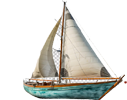

Halyard (Jib)
Return To Index
A jib halyard is a dedicated line (rope or wire) used to hoist and tension the jib sail's luff, running from the cockpit through mast sheaves to the head of the sail. It is critical for controlling sail shape, with tension adjusted via cleats or cascades, and often features a shackle for quick attachment.
Key Features and Components
Purpose: To raise, lower, and apply tension to the luff (front edge) of the jib.
Attachment: Connects to the head (top corner) of the jib using a shackle or a bowline knot.
Routing: Passes through a sheave (pulley) at the top of the mast and usually leads back to the cockpit for adjustment, often handled with cleats or jammers.
Materials: Modern halyards often use low-stretch, high-strength synthetic fibers (Dyneema, polyester), though some older boats may use wire-to-rope combinations.
Tensioning: A "jib halyard fine" tune or cascade system may be used to adjust tension to alter sail shape, similar to a Cunningham.
Continuous System: Some dinghies, such as Thistle Class boats, use a continuous loop for the jib halyard to allow rapid adjustment, including a shock cord for tensioning.
Key Features and Components
Purpose: To raise, lower, and apply tension to the luff (front edge) of the jib.
Attachment: Connects to the head (top corner) of the jib using a shackle or a bowline knot.
Routing: Passes through a sheave (pulley) at the top of the mast and usually leads back to the cockpit for adjustment, often handled with cleats or jammers.
Materials: Modern halyards often use low-stretch, high-strength synthetic fibers (Dyneema, polyester), though some older boats may use wire-to-rope combinations.
Tensioning: A "jib halyard fine" tune or cascade system may be used to adjust tension to alter sail shape, similar to a Cunningham.
Continuous System: Some dinghies, such as Thistle Class boats, use a continuous loop for the jib halyard to allow rapid adjustment, including a shock cord for tensioning.