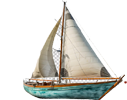

Mainsail
Return To Index
A mainsail is the primary, usually triangular sail located aft of the mast, defined by three corners—head (top), tack (front-bottom), and clew (back-bottom)—and three edges—luff (front), leech (back), and foot (bottom). It provides most of the driving force and is adjusted using battens for shape and rigging like the mainsheet and outhaul.
On a square rigged vessel, it is the lowest and largest sail on the main mast.
On a fore-and-aft rigged vessel, it is the sail rigged aft of the main mast. The sail's foot is normally attached to a boom. (In extremely heavy weather, the mainsail may be lowered, and a much smaller trysail hoisted in its place).
Historical fore-and-aft rigs used a four-sided gaff rigged mainsail, sometimes setting a gaff topsail above it.
Whereas once the mainsail was typically the largest sail, today the mainsail may be smaller than the jib or genoa; Prout catamarans typically have a mainmast stepped further aft than in a standard sloop, so that the mainsail is much smaller than the foresail.
Some mainsails are "full-batten" mainsails, meaning the batten extends all the way from the mast to the leach of a sail. A partial batten extends from the leech partway to the mast. Battens enable the mainsail to project farther away from the mast. However, there is some cost associated with the battens themselves, "batten pockets" need to be sewn into the sail, and "batten cars" may be needed to allow the sail to be raised and lowered.
On a square rigged vessel, it is the lowest and largest sail on the main mast.
On a fore-and-aft rigged vessel, it is the sail rigged aft of the main mast. The sail's foot is normally attached to a boom. (In extremely heavy weather, the mainsail may be lowered, and a much smaller trysail hoisted in its place).
Historical fore-and-aft rigs used a four-sided gaff rigged mainsail, sometimes setting a gaff topsail above it.
Whereas once the mainsail was typically the largest sail, today the mainsail may be smaller than the jib or genoa; Prout catamarans typically have a mainmast stepped further aft than in a standard sloop, so that the mainsail is much smaller than the foresail.
Some mainsails are "full-batten" mainsails, meaning the batten extends all the way from the mast to the leach of a sail. A partial batten extends from the leech partway to the mast. Battens enable the mainsail to project farther away from the mast. However, there is some cost associated with the battens themselves, "batten pockets" need to be sewn into the sail, and "batten cars" may be needed to allow the sail to be raised and lowered.