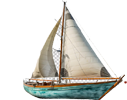

Schooner
Return To Index
A schooner is a type of sailing vessel defined by having two or more masts, with the foremast (forward mast) being shorter than or equal in height to the mainmast (aft mast). Primarily rigged with fore-and-aft sails, they are highly maneuverable, fast, and often feature gaff-rigged sails, making them versatile for coastal trading and ocean sailing.
Key Characteristics and Design
Mast Configuration: Unlike ketches or sloops, a schooner's mainmast is located aft, and it is the tallest mast.
Sails: They typically use fore-and-aft sails, which run lengthwise along the boat. Traditional schooners often feature gaff-rigged sails (four-sided, supported by a spar at the top) or modern Bermuda sails.
Rigging: Schooners can have two, three, or even up to seven masts.
Speed & Handling: The design offers a balanced helm, making it efficient in changing coastal winds and capable of sailing quickly, especially downwind.
History and Usage
Origin: Developed in the early 18th century (around 1713) in British North America, with the first one often attributed to shipbuilder Andrew Robinson in Gloucester, Massachusetts.
Key Characteristics and Design
Mast Configuration: Unlike ketches or sloops, a schooner's mainmast is located aft, and it is the tallest mast.
Sails: They typically use fore-and-aft sails, which run lengthwise along the boat. Traditional schooners often feature gaff-rigged sails (four-sided, supported by a spar at the top) or modern Bermuda sails.
Rigging: Schooners can have two, three, or even up to seven masts.
Speed & Handling: The design offers a balanced helm, making it efficient in changing coastal winds and capable of sailing quickly, especially downwind.
History and Usage
Origin: Developed in the early 18th century (around 1713) in British North America, with the first one often attributed to shipbuilder Andrew Robinson in Gloucester, Massachusetts.